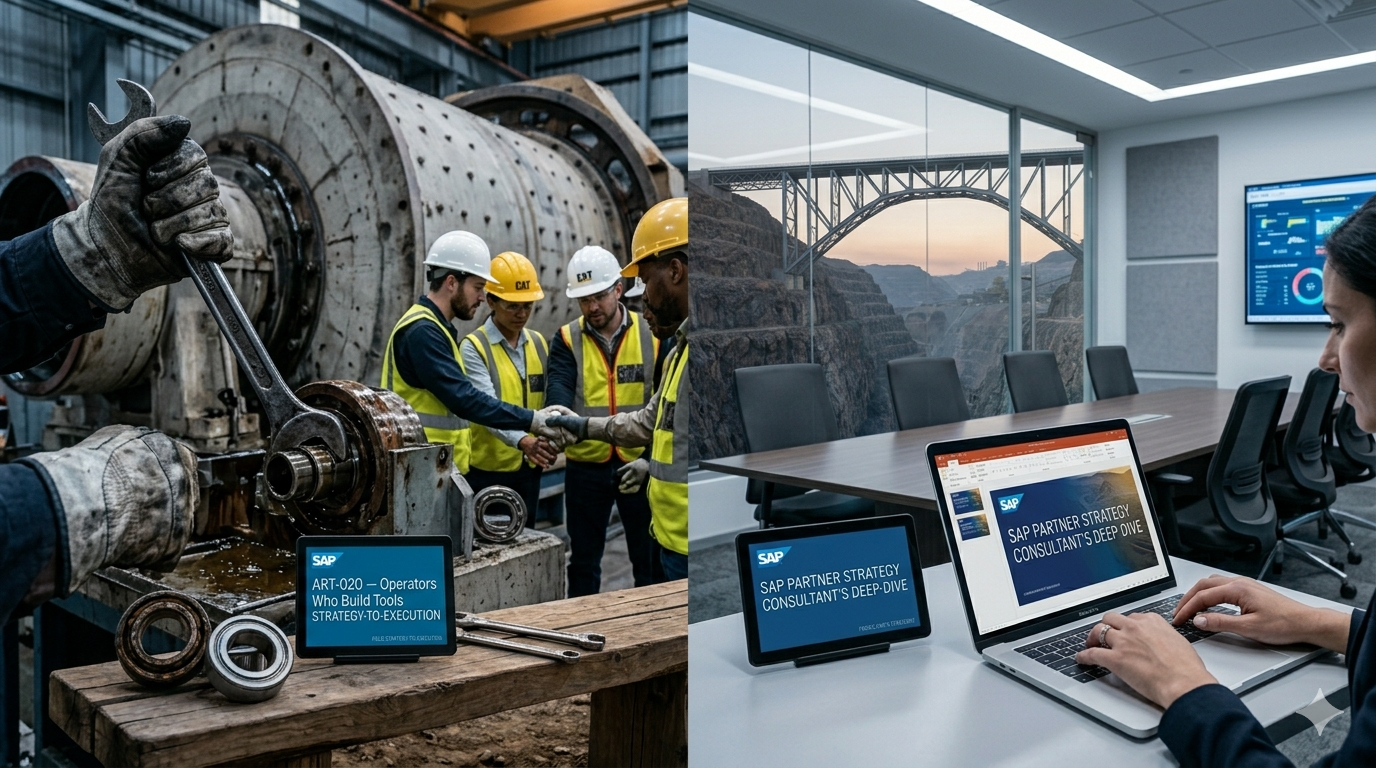
Three years ago, a mining company in Peru hired an international consultancy to design its maintenance strategy.
Twelve months. A team of eight consultants. Dozens of workshops, interviews, and presentations.
The final deliverable: 400 pages of PowerPoint and an implementation plan that required, to execute, the same consultants for another six months.
When the contract ended, the consultants left. They took the context. The details of why each decision was made. The deep understanding of that plant's specific process. The knowledge accumulated over months of immersion.
The company was left with documents. Without the capacity to execute what those documents said.
Back to square one.
This is not an exceptional case. It's the standard business model of traditional consulting.
The Body-Shop Model: Designed for Dependency
Traditional consulting has a structural problem. It's not intentionally bad. It's the result of how the business model was built.
Billable hours — charging for time, not results — is the wrong incentive. Every hour the client can solve on their own is an hour the consultancy doesn't bill. Every capability the client develops internally is a future contract that disappears.
The economic logic of the model isn't aligned with the client's interests.
McKinsey, BCG, Bain operate with the same logic at different prices. Between $500,000 and $2 million per month. Engagements of 9 to 12 months. PowerPoints documenting what should be done, but not building internal capacity to do it.
According to consulting industry data, more than 70% of organizational transformation projects fail to sustain proposed changes beyond 18 months. Not because the recommendations are wrong. But because the knowledge to execute, maintain, and adapt them stayed with the consultancy — not in the client organization.
When they leave, they take everything.
When They Leave, What Remains?
The question no consulting RFP asks to answer.
At the end of a typical engagement, the client has documents. Has recommendations. Has, if the project was successful, some implemented changes. But doesn't have the installed capacity to continue, adapt, or scale what was started.
The mining industry has a datum illustrating the magnitude: more than 50% of Codelco's workforce are contractors. When that personnel rotates, the company faces the same thing as when a consultancy leaves. Mining Magazine documents it precisely: "knowledge loss when contractor personnel rotate is persistent."
The IAM adds another dimension: "Organizations expect technology to solve organizational and process problems." The typical response when knowledge leaves is: buy another system. Implement another platform. Hire another consultancy.
The cycle repeats. The knowledge still doesn't stay.
Installed Capacity vs Eternal Dependency
There's a fundamental difference between delivering a result and building capacity.
Delivering a result means: at the end of the engagement, the problem is solved. The document is written.
Building capacity means: at the end of the engagement, the organization can solve that type of problem on its own. It has the method, the tool, and the internal knowledge to execute, measure, and continuously improve without depending on the same consultant coming back.
Mining Magazine frames it from risk: "heavy reliance on contractors introduces quality, safety, and consistency risks." Dependency on external knowledge isn't just costly. It's an operational risk.
A Different Model: The Result AND the Tool
At VSC we built our model from a real frustration.
We come from operating mines and megaprojects across four continents. We lived in the trenches the problems we solve. And we directly experienced what happens when an external consultancy delivers its report and leaves.
We decided to build a firm that did exactly the opposite.
We don't just deliver the result. We deliver the result and the tool to sustain it.
Operational Readiness in 90-120 days. Asset strategy in 63 hours. Savings of $160,000 to $213,000 per project — as installed capacity the client can replicate.
The concept we use internally is Corporate Second Brain. It's not a PDF deliverable. It's the engagement's critical knowledge codified in the client's organization in a structured, actionable way.
The difference with McKinsey: they produce strategies the client needs to hire more consultants to implement. We implement — with top-tier quality and startup speed.
The difference with the billable hours model: there's no incentive for the engagement to last longer. The incentive is for the client to achieve measurable results as quickly as possible and keep the capacity to sustain them.
The Question You Should Ask Your Next Consultant
Before signing the next consulting contract, a single question changes everything:
"When you leave, what capacity remains inside my organization?"
If the answer is "a report" or "the implemented recommendations," you already know what you're buying.
The alternative exists. Not in theory — in practice, with measurable numbers and validated methodology.
We deliver the result and the tool. In weeks, not years. And what we build stays in your organization.
Schedule a meeting with the VSC team.
ValueStrategy Consulting — Accelerated operational solutions and agentic software for the industry that can't stop.
Ready to talk about your operation?
30 minutes. Your specific case. Honest assessment.
Schedule a Meeting with VSCSources
- Consulting industry data — Transformation project sustainability rates (70%+ failure beyond 18 months)
- Mining Magazine — Contractor workforce knowledge loss at Codelco
- IAM (Institute of Asset Management) — Technology vs organizational capability