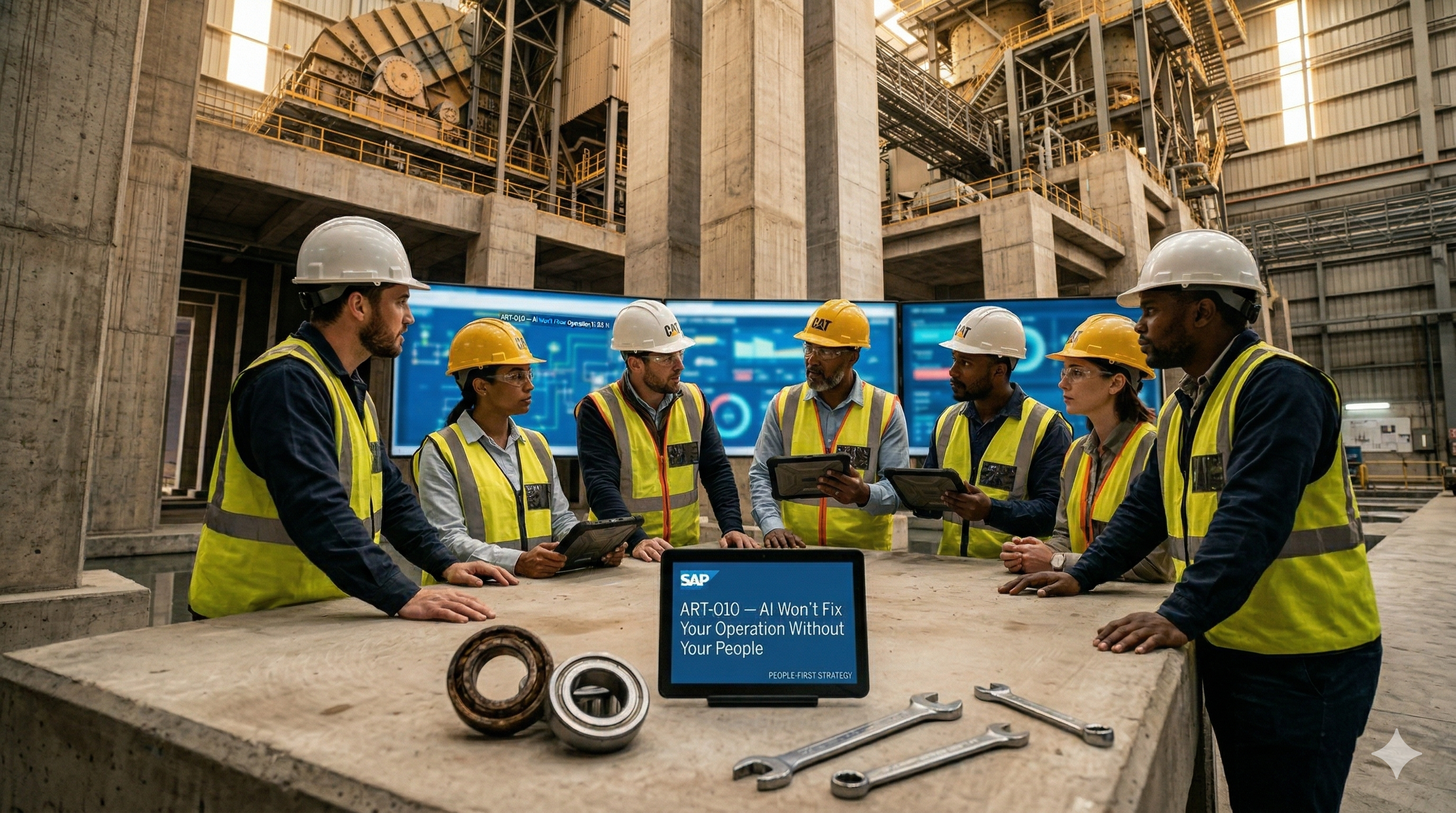
48% of digital initiatives don't meet their objectives. That's not a startup or university experiment figure. It's from a Gartner survey of 4,200 business leaders worldwide.
And in the mining industry the number is even more brutal.
60-70% of digital transformation projects in mining don't scale beyond the pilot. The project starts, the demo is shown, the CEO appears in a photo with the software vendor, and six months later the tool is installed but nobody uses it.
The uncomfortable answer: because the problem was never technological.
The Promise vs Reality
The promise: "Implement AI and reduce operating costs by 30%." "Digitize maintenance and eliminate unplanned shutdowns."
The reality the maintenance manager lives on Monday morning: 15 to 30 active software systems in the operation (Mining-Technology.com). Most don't talk to each other. CMMS work order completion rates with failure data below 30% (E&MJ).
Predictive AI maintenance vendors recognize in their own technical documents: ML models for failure prediction require sufficient historical failure data, and most mines simply don't have clean historical data.
MIT Sloan's diagnosis: organizations adopt new technologies without adequate change management, without sufficient training, and without process redesign. Technology arrives first. People adapt later, if they adapt at all.
Why Digital Initiatives Fail
Board urgency. Mining boards demand ROI in 2-3 years for digital investments that frequently require 5+ years to mature (Mining Global). Pilots are declared successful before scalability is validated.
Data quality. If the CMMS has failure data completion below 30%, the model learns from incomplete data. Predictions become unreliable. Engineers stop trusting the system.
System fragmentation. With 15 to 30 tools per operation, integrating real-time data isn't a software problem. It's an organizational architecture problem.
The Human Factor: The Enabler Nobody Mentions in the Demo
66% of executives expect fundamental changes to their operating models in three years (MIT Sloan/BCG).
But the real bottleneck: the key isn't having the right technology. It's having a "digitally dexterous" workforce — capable of using the tools AND willing to do so.
A reliability engineer with 15 years of experience won't change their workflow because the IT director installed a new tool. They'll change when they see the tool saves them three hours of manual analysis. When their FMECA comes out faster and with better quality.
That's not technology. That's change management.
Prepare Before Automating
Before automating a process, that process has to be documented. Before installing predictive maintenance AI, historical data quality has to meet a minimum bar. Before deploying an operational planning tool, the people who will use it need to understand why their current decisions are suboptimal.
Organizational readiness is the enabler, not the technology.
Four dimensions require honest assessment:
1. Data quality. Are maintenance, production, and asset data sufficiently complete and reliable to feed a model?
2. Documented processes. Are critical operational decisions documented in reproducible processes or do they live in senior engineers' heads?
3. Team capabilities. Does the team have technical context to interpret outputs and act accordingly? Training on "how to use the screens" isn't sufficient.
4. Governance and adoption. Who is the internal champion? How will results be measured? What happens when the system gives a recommendation the experienced engineer doesn't accept?
None of these four factors is technological. All are organizational.
The Difference Between Selling Software and Implementing Capability
Selling software is transferring a license and giving user training. Implementing capability means preparing the organization for the tool to generate sustained value after the external team leaves.
The difference between both approaches isn't visible on installation day. It's visible six months later.
At VSC, our position is explicit: organizational readiness is the enabler, not the technology. When we deploy agentic software in an organization, work starts before installation — in the maturity diagnosis, data evaluation, and process design. And it continues after, in adoption support and measurement of real results.
We don't sell licenses. We install capability.
Schedule a meeting with the VSC team. We evaluate your organization's operational readiness — in data, processes, and team — before recommending any tool. Because the right technology in an unprepared organization is just another license nobody uses.
Ready to talk about your operation?
30 minutes. Your specific case. Honest assessment.
Schedule a Meeting with VSCSources
- Gartner — Digital initiative success rates (survey of 4,200 business leaders)
- Mining-Technology.com — Software system count per mining operation (15-30)
- E&MJ (Engineering & Mining Journal) — CMMS failure data completion rates
- MIT Sloan / BCG — Executive expectations on operating model changes (66%)
- Mining Global — Digital investment ROI timelines in mining
.png)
