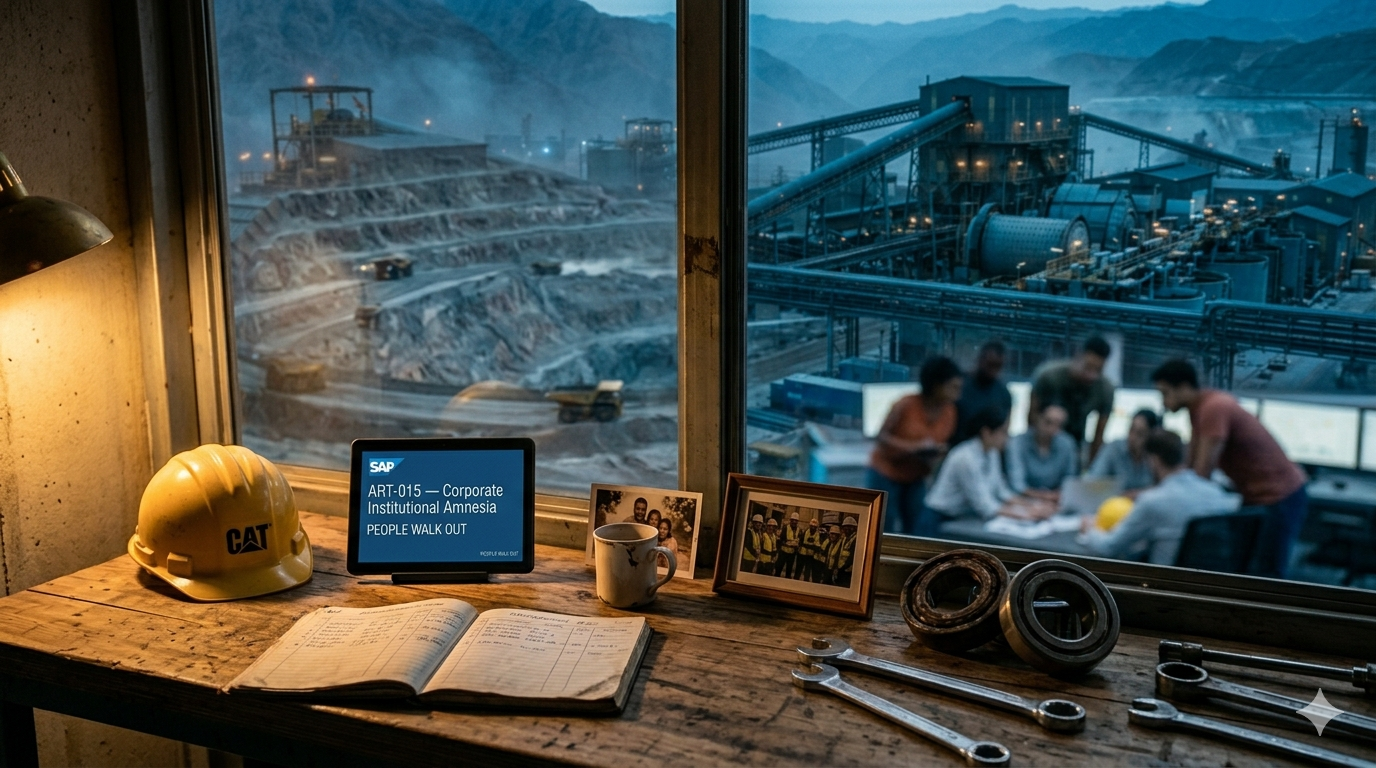
When your senior engineer with 20 years of experience retires, you don't lose a person.
You lose 20 years of decisions, corrected errors, and knowledge that was never documented.
You lose the "why this equipment has this specific configuration and not another." The "last time we did this, X happened, and we had to adjust Y." The "never do Z on this shift because the system behaves anomalously between 2 and 4 AM."
That knowledge isn't in any manual. It's not in the CMMS. It's not in the ERP.
It was in one person's head. And that person just walked out the door.
The mining and energy industry has spent decades building assets worth billions of dollars. But it has systematically failed to build the asset that makes them work: organizational knowledge.
That has a name. At VSC we call it Corporate Institutional Amnesia.
And it is, without exaggeration, heavy industry's most underestimated threat today.
The Numbers of Amnesia
Industry estimates indicate approximately 50% of mining talent eligible for retirement will retire within the next 10 years. Not in generations. In one decade.
More than 50% of Codelco's workforce are contractors. When that personnel rotates, the company faces knowledge loss. Mining Magazine documents it: "knowledge loss when contractor personnel rotate is persistent."
According to SMRP, the aging workforce is generating an unprecedented knowledge transfer crisis. Knowledge workers lose 1.8 hours per day searching for information that should be immediately available (IDC). In a plant with 200 people, that's 90,000+ hours per year.
How It Manifests in Operations
In maintenance: 30-50% of bearing failures are caused by incorrect installation or inadequate lubrication, not component defects (ReliabilityWeb). The correct technique lives in the memory of the technician with 15 years of experience who no longer works there.
In work execution: Wrench time averages 25-35% (SMRP). Part of the rework is avoidable — because someone learned a more efficient path but that learning was never systematically captured.
In data quality: Failure modes, root causes, and corrective actions aren't recorded consistently. Organizations are "data-rich and information-poor" (Intelligent Mine).
In operator variability: The performance difference between the best and worst operator of the same equipment can be 20-30% (Mining Magazine). The high-performing operator has tacit knowledge about that specific equipment. That knowledge is rarely captured.
In SOP compliance: SOP compliance rates frequently fall below 60% (Mining Magazine). Often because the SOP is outdated or because the reasoning behind each step isn't explained.
The Corporate Second Brain: Knowledge That Stays
At VSC we developed the concept we call Corporate Second Brain.
It's not software. It's not a database. It's not a document repository.
It's a living system for capturing an organization's critical knowledge and converting it into permanent capability.
A database accumulates information. The Corporate Second Brain accumulates structured, actionable knowledge. Information answers "what." Knowledge answers "why," "how," "when," and "what happens if not."
When an expert with 20 years of experience works within such a system, their knowledge doesn't disappear when they leave. It stays codified in the organization. Not as a static manual nobody reads, but as structured knowledge guiding the next team's decisions.
The Question You Should Ask Today
If tomorrow your most experienced operator, your 18-year plant maintenance chief, your reliability specialist who knows every quirk of the process retired — what would happen?
If the honest answer is "we'd lose critical knowledge not documented anywhere," you already have the problem described in this article.
ValueStrategy Consulting — Accelerated operational solutions and agentic software for the industry that can't stop.