The FMECA is there. The RCM analysis is there. The maintenance plans too.
The problem: none of it is in SAP PM. None of it is implemented. Your operations team starts the ramp-up in the same reactive mode as always.
This article explains why that happens, how much it costs, and how VSC solves it in 63 hours.
The Problem: Strategies That Never Get Implemented
The gap between "having a maintenance strategy" and "implementing it" is larger than the industry admits.
According to ReliabilityWeb, most industrial organizations have performed RCM analyses. The findings exist. The problem: they're neither implemented nor sustained over time. They're consultancy documents sleeping in a shared folder.
The same pattern applies to FMECA. According to ReliabilityWeb, FMECA analyses are performed during the design stage. But they're almost never updated with real operational experience. The plant starts up, fails in ways the design didn't anticipate, and the original FMECA becomes obsolete from the first quarter.
CMMS data quality confirms it. According to Engineering & Mining Journal (E&MJ), the completion rate of work orders with significant failure data is less than 30% in most operations. The information you need to make maintenance decisions simply doesn't exist in your system.
And it's not just the CMMS. The International Asset Management (IAM) documents that asset registers are incomplete or inaccurate in a significant proportion of organizations — many cannot list with certainty all the assets they own. Bill of Materials accuracy is less than 50% at many sites, according to SMRP.
The result is predictable: maintenance cost as a percentage of Replacement Asset Value (RAV) averages between 5% and 8% in the industry. Best practices establish 2% to 3%. That difference — 2 to 5 RAV points — represents tens or hundreds of millions of dollars in large-scale assets.
Finally, there's a substance vs. certification problem. The IAM reports that many organizations pursue ISO 55001 certification without genuine transformation. They have the certificate. They don't have the change.
The diagnosis is clear: the industry doesn't have a knowledge problem. It has an implementation problem.
500 Hours of Manual Work
Developing a complete Asset Management Strategy (AMS) traditionally takes, on average, 500 hours of work.
That number isn't a conservative estimate. It's the reality of doing this work manually: collecting asset data scattered across multiple systems, executing criticality analysis equipment by equipment, building the FMECA from scratch, defining maintenance tactics for each identified failure mode, calculating optimal intervention frequencies, and finally — if the client is lucky — structuring the data so someone can load it into SAP PM.
The process has structural problems that go beyond time.
First, consistency. When the analysis is done by 3 or 4 engineers in parallel, each one applies slightly different criteria. The result is an inconsistent FMECA that generates endless review debates.
Second, traceability. It's difficult to demonstrate why each decision was made. When the client asks "why is this pump on preventive maintenance every 1,000 hours and not every 500?", the honest answer is frequently "because the engineer who did that analysis 4 months ago decided so."
Third, and most critical: the final deliverable. After 500 hours of work, most engagements end with a PDF or an Excel. The client receives a document they cannot load directly into their CMMS. Someone from the operations team has to manually translate that document to SAP PM. That translation process introduces errors, takes additional weeks, and frequently isn't completed because the project already "ended" and the consulting team is no longer available.
The criticality analysis was done. The maintenance data was generated. SAP PM stays the same as before.
From FMECA to SAP PM in 63 Hours
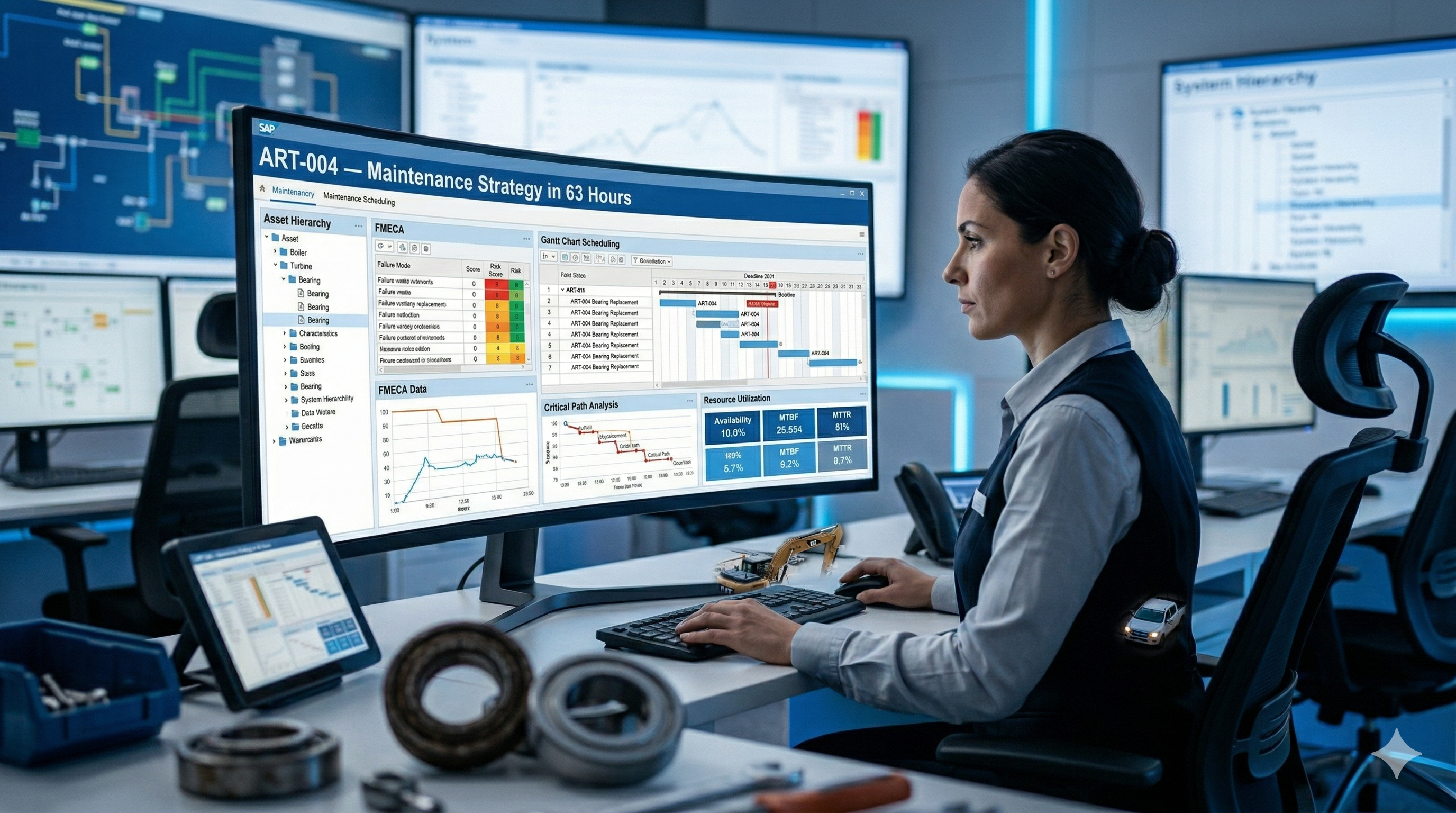
VSC delivers a complete AMS in 63 hours. That represents an 87% reduction versus the traditional method.
The differentiator isn't speed for speed's sake. It's speed with verifiable quality.
VSC's proprietary analytical framework generates criticality-based maintenance strategies. It's not a manual process of engineers working in parallel with different criteria. It's a systematized process where criteria are consistent by definition, traceability is built in from the start, and results are auditable at every decision.
The logic is "the expert validates, the system accelerates." VSC's system doesn't replace the engineer's judgment — it amplifies it. The engineer defines the criticality parameters, reviews the generated analyses, and validates the resulting plans. What's eliminated is the repetitive work of collecting, structuring, and calculating. The engineer invests their time where they add real value: in the decisions that require their experience.
Quality is measurable. VSC measures output quality across 7 specific dimensions. The average result is 91 out of 100. That's not a marketing promise — it's an auditable metric the client can verify.
The average savings per AMS project is $65,000. That number combines the reduction in consulting hours (which translates directly into lower fees) and the avoided cost of rework during the implementation phase.
And the deliverable is not a PDF.
VSC exports directly to SAP PM. The maintenance plans generated in the process come out in a format ready to load into the client's CMMS. There's no manual translation intermediary. No second "data implementation" phase. The operations team receives data ready to use the day the engagement is delivered.
This is the fundamental differential versus Mindco, ReliaSoft, or HolisticAM: we don't diagnose and deliver a document. We deliver an implemented strategy.
Mindco has 20 years in Chile and Tier 1 clients. They diagnose well. But Mindco's FMECA ends in a report. VSC's ends in SAP PM.
ReliaSoft has the most complete technical suite on the market for reliability — Weibull++, BlockSim, Xfmea, RCM++. The problem: it requires an expert engineer for each module. It doesn't automate the analysis. It's an isolated tool the client has to operate. With VSC, the proprietary analytical framework generates the analyses and the expert validates. The difference isn't just speed — it's the complete working model.
HolisticAM operates in the same niche. The difference is delivery speed: 10 times slower than VSC on comparable projects.
Measurable Quality, Not Promised
The speed-without-quality argument is irrelevant for industrial operations.
A poorly constructed maintenance strategy that arrives quickly only accelerates problems. A critical pump with incorrect intervention frequency costs much more than the consultant's fees.
That's why VSC measures quality across 7 dimensions on every delivery. The 7 dimensions cover asset analysis completeness, criticality criteria consistency, failure mode coverage, alignment with industry best practices (including ISO 55000), integrity of data exported to SAP PM, traceability of decisions made, and operational applicability of defined tactics.
The average score is 91/100.
That number has a direct implication for the client: there's a measurable baseline to compare against. If in the next strategy review — 12 or 18 months later — the score drops, there's a clear signal of deterioration that can be diagnosed and corrected. If the score rises, there's evidence of continuous improvement.
The industry is accustomed to receiving quality as a concept. VSC delivers it as a metric.
This philosophy reflects a VSC positioning principle: "We implement operations with top-tier quality and startup speed." It's not a phrase — it's the service design.
What the Market Doesn't Want to Hear
There are three truths the industry avoids about maintenance strategy.
First: the design FMECA is an engineering document, not an operational strategy. The asset that leaves the factory and the asset operating under real conditions at 18 months are two different entities. A maintenance strategy that isn't updated with real operational data is a technical fiction. According to E&MJ data, the rate of work with significant failure data is less than 30%. If the CMMS doesn't capture real failures, the maintenance strategy has no feedback. It's static by definition.
Second: ISO 55001 certification without genuine transformation is a reputation problem, not a compliance one. The IAM documents this pattern systematically. Organizations that pursue certification as a terminal objective — not as the result of a real transformation — end up with two problems: the cost of certification and the gap between what the certificate says and what happens in the plant. Maintenance cost as a percentage of RAV doesn't lie. If it's between 5% and 8%, the certificate doesn't reflect operational reality.
Third: a PDF is not a consulting deliverable — it's an artifact from a consultancy that didn't want to commit to implementation. The value of a maintenance strategy isn't in the document. It's in what changes in the plant when that strategy is executed. A strategy in SAP PM gets executed. A strategy in PDF waits.
These three problems have solutions. They're not complex solutions. It's a matter of choosing a partner who understands that their job ends when the strategy is working, not when the document is delivered.
Why 63 Hours Matters on a $500M Project
In large-scale mining and energy projects, the cost of a deficient ramp-up is measured in lost production during the first months of operation.
A $1,000 million megaproject with six months of delay in reaching its target production rate can lose between $50 million and $100 million in revenue. That's the real scale of the problem a well-built and implemented maintenance strategy solves.
In that context, the difference between 500 hours and 63 hours isn't an efficiency optimization. It's the difference between having the maintenance strategy ready before commissioning — when there's still time to train the team, load the CMMS, and prepare service contracts — or receiving it as a retrospective report three months after the plant has already started up.
VSC's 63 hours are designed to fit a project's schedule. They're not an academic post-startup exercise. They're an operational deliverable with a defined use date.
And the $65,000 savings per AMS project, combined with the reduction in CMMS implementation errors, has a direct return on engagement fees. In projects where the cost of reactive maintenance represents the difference between 2% and 8% of RAV, the investment in a well-built strategy has a return multiple that no other optimization initiative can match in the same timeframe.
Ready to talk about your operation?
30 minutes. Your specific case. Honest assessment.
Schedule a Meeting with VSC