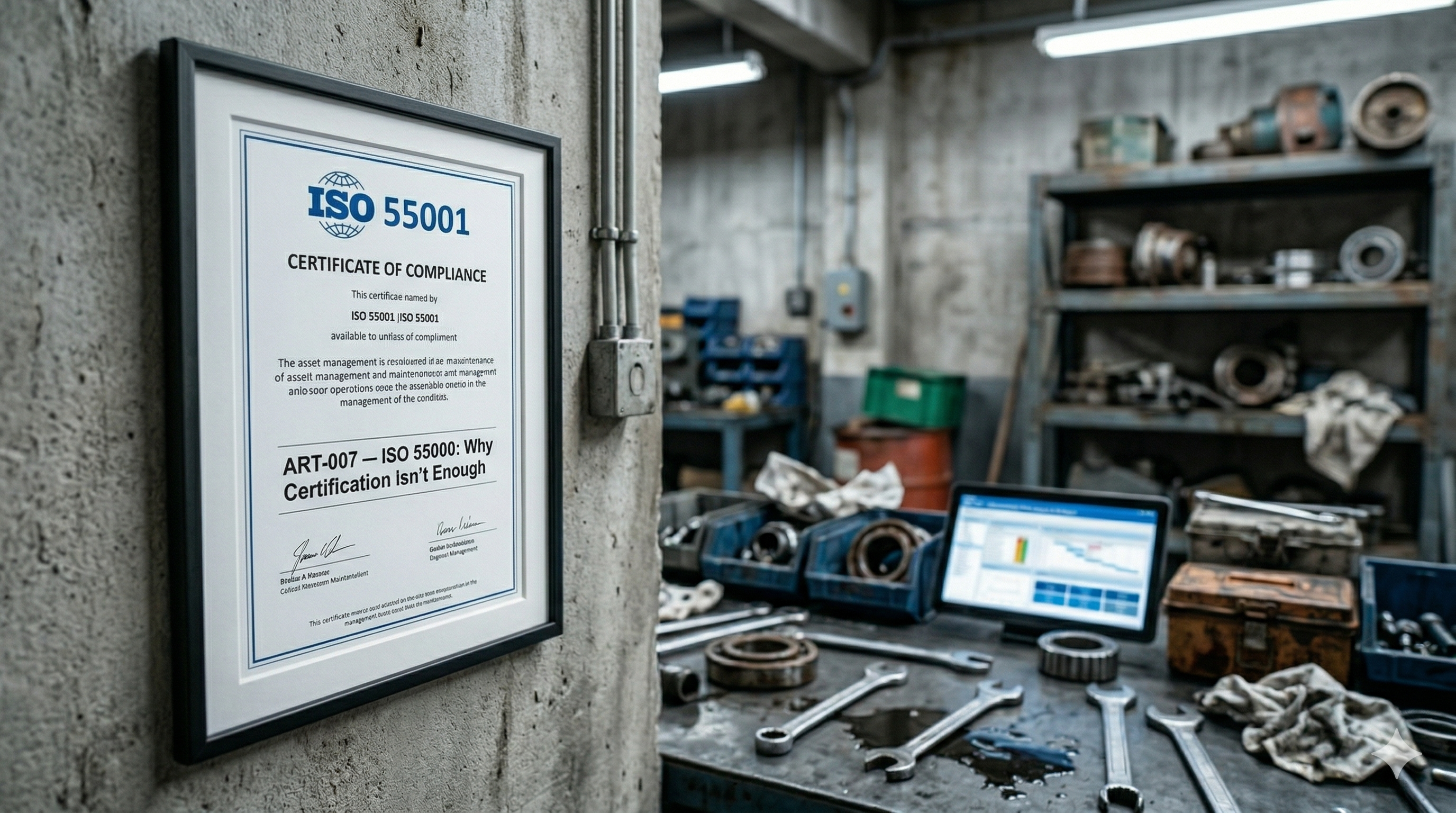
The plaque on the wall says ISO 55001 certified.
The assets keep failing without warning. The asset register has data from three years ago. Engineers keep running to fight fires. And the EAM — that system that cost millions — functions primarily as a work order system.
Certification isn't the problem. The problem is what comes after getting it.
The Certification Mirage
There's a fundamental confusion in the industry: thinking that ISO 55001 is a project with a closing date.
The consultant is hired. Documentation gaps are filled. The audit is passed. Everyone celebrates. And six months later, the organization operates exactly as before.
According to Australia's Asset Management Council, most organizations treat ISO 55001 as a certification project, not as a continuous management system. The difference isn't semantic. It's the difference between a photograph and a movie.
ISO 55000 — the normative framework that includes ISO 55001 as the requirements standard and ISO 55002 as the implementation guide — defines asset management as the systematic coordination of activities and practices through which an organization manages its assets and their risks, costs, and performance throughout their lifecycle.
The keyword is systematic. Not eventual. Not when there's an audit. Systematic.
The IAM (Institute of Asset Management) documents something many executives prefer not to hear: organizations consistently overestimate their maturity level when self-assessing. Internal perception of capability exceeds operational reality. And that has direct consequences on decisions that are made — or not made.
Level 2: Where Most Get Stuck
The IAM maturity model has five levels: Innocent, Aware, Developing, Competent, and Optimizing.
Most industrial organizations — including certified ones — get stuck at Level 2 (Developing).
That means they have policies and some documented processes. Someone in the organization understands what lifecycle costing is. But day-to-day operational decisions aren't made within that framework. They're made with urgency, intuition, and the personal experience of the shift technician.
The jump from Level 2 to Level 3 (Competent) is where most asset management initiatives break. Not for lack of will. For three concrete reasons:
First: Operational pressure crushes strategic management. When the plant stops, nobody's thinking about asset maturity. That's rational short-term. Destructive long-term.
Second: Asset management is still perceived as a maintenance function, not as a board-level strategic capability. The IAM documents this explicitly: in most organizations, asset management doesn't reach the board with the same rigor as financial management or risk management.
Third: The ISO 55000 framework covers 39 subjects according to the IAM Anatomy of Asset Management. Most certified organizations demonstrate real competence in fewer than 10. The rest is documented, not operationalized.
Certification proves the organization has the system. Not that it uses it.
The 5 Most Common Gaps
Gap 1: The Asset Register Is an Illusion
The IAM states directly: incomplete or inaccurate asset registers are one of the most widespread problems in asset management practice. You can't optimize the lifecycle of an asset that doesn't formally exist in the system.
Gap 2: The EAM Is a Work Order Box
According to SMRP, Enterprise Asset Management systems are primarily used as work order tracking tools, not as decision support platforms. A system that generates backlog reports isn't an asset management system.
Gap 3: Lifecycle Costing Exists in the Manual, Not in Decisions
The IAM documents that decision-making frameworks — including lifecycle costing — are rarely applied rigorously in practice. Investment decisions in assets are made with the same level of analytical rigor they've had for twenty years.
Gap 4: Maintenance and Asset Management Are Used as Synonyms
The GFMAM identifies this confusion as one of the most persistent barriers to effective ISO 55000 implementation. Maintenance is tactical. Asset management is strategic. An organization can have an excellent maintenance department and a deficient asset management strategy.
Gap 5: Mining Is Average, Not Cutting-Edge
The GFMAM publishes comparative benchmarks by sector. Mining sits "in the middle of the pack" in asset management maturity, behind utilities and oil and gas.
From Certification to Real Capability
Certification is the floor, not the ceiling. Reaching Level 3 or above requires three changes not included in the audit process:
Change 1: Treat ISO 55001 as an operating system, not a project. A functioning asset management system has real operational owners with clear mandates and performance metrics linked to asset decisions.
Change 2: Connect asset management with financial decisions. Investment justification in assets — replacement, rehabilitation, new CAPEX — should pass through a documented lifecycle costing process.
Change 3: Close the gaps in the IAM Anatomy, not just those required for audit. Reaching Level 3 requires real competence in areas like Asset Knowledge Management, Decision-Making, and Lifecycle Value Realization.
How VSC Works in Asset Management Strategy
At VSC we deliver Maintenance Strategy aligned with ISO 55000 — in 63 hours of effective work, not weeks of extensive consulting.
We're not an audit firm. We don't arrive to review your documentation and produce a gap assessment in PDF.
We arrive as former operators who have managed assets in mining and energy megaprojects across four continents. And we arrive with proprietary methodology covering critical asset management dimensions: asset criticality, maintenance strategies by class, applied lifecycle costing, OPEX cost structure, and management KPIs linked to decision-making.
The differentiator isn't just speed. It's that the generated knowledge stays in the client's organization.
ISO 55001 certification proves the organization has the system.
VSC helps make the system work.
Schedule a meeting with the VSC team. In 30 minutes we can identify where on the maturity curve your organization sits and what concrete changes would move the needle.
ValueStrategy Consulting delivers Operational Readiness and Asset Management Strategy for mining, energy, and megaproject operations. Quality, accelerated delivery, and value generated through in-house proprietary tools and methodology.
Ready to talk about your operation?
30 minutes. Your specific case. Honest assessment.
Schedule a Meeting with VSCSources
- Australia's Asset Management Council — ISO 55001 implementation practices
- IAM (Institute of Asset Management) — Maturity model and self-assessment findings
- IAM Anatomy of Asset Management — 39 subjects framework
- SMRP (Society for Maintenance & Reliability Professionals) — EAM usage patterns
- GFMAM (Global Forum on Maintenance and Asset Management) — Sector benchmarks and barriers