There's a line item that doesn't appear in any megaproject budget.
It's not in the CAPEX estimate. It's not in the first-year OPEX model. Nobody approves it in the investment committee. But it gets paid anyway.
It's the cost of not being ready to operate.
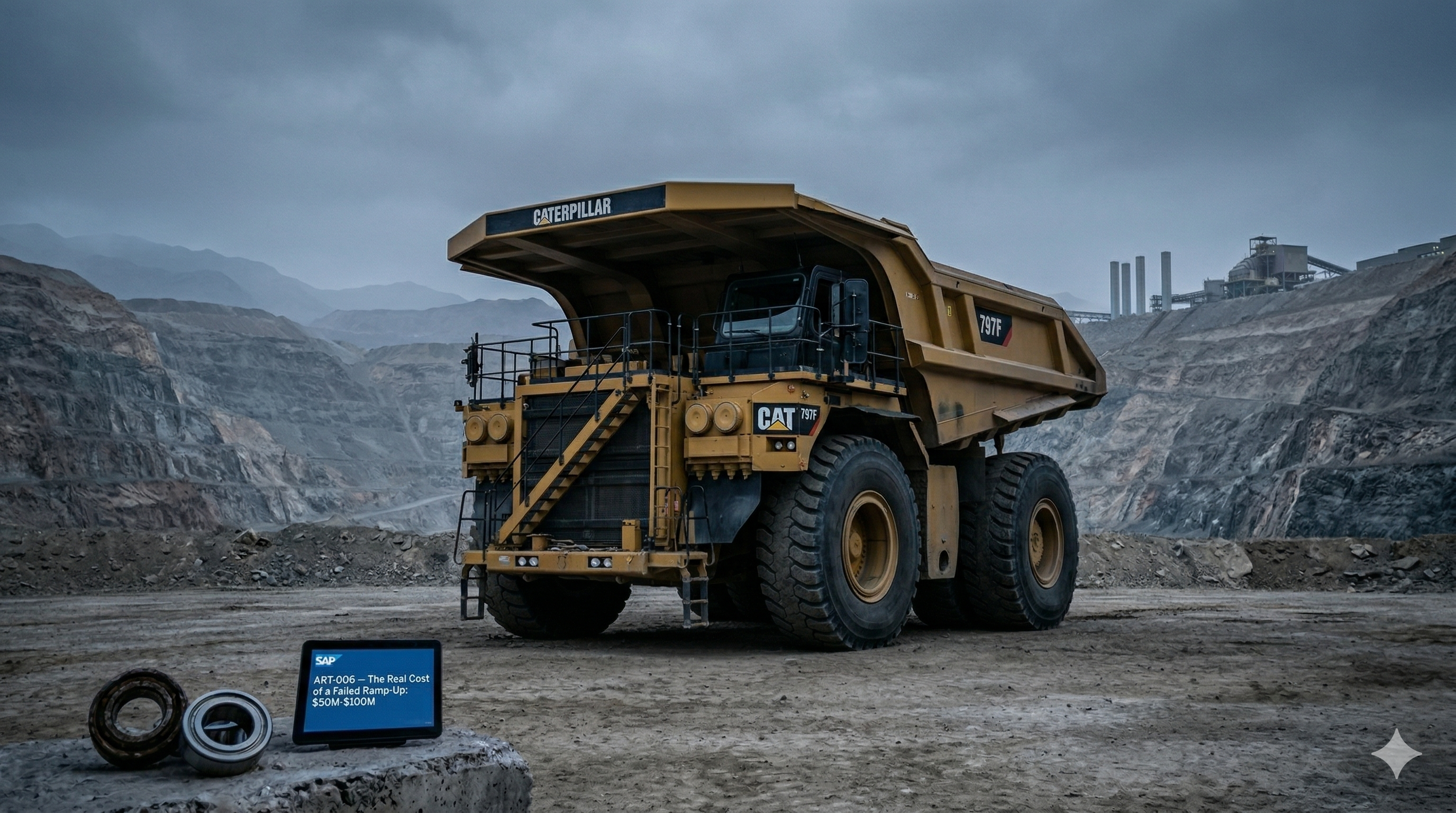
A USD 1 billion megaproject that suffers six months of ramp-up delay loses between USD 50 million and USD 100 million in unrealized production. That's 5% to 10% of the total project cost — evaporated before the operation reaches nameplate capacity.
And that figure doesn't include first-year OPEX overruns, contractual penalties, deterioration of relationships with partners and financiers, or the impact on stock price.
That's the real cost of a failed ramp-up. And in most projects, nobody budgets for it.
The Mathematics of Delay
The industry numbers are coherent and consistent.
According to Engineering & Mining Journal, capital projects in mining present average cost overruns of 30% to 50% of the original budget. McKinsey documents that 70% of megaprojects accumulate delays exceeding 12 months. Boston Consulting Group calculates that the "valley of death" — the period between commissioning and full operational capacity — consumes 5% to 15% of total project CAPEX.
But the data point that should most concern any project director isn't the CAPEX: it's the OPEX.
According to Deloitte, 60% of industrial projects exceed the first-year OPEX budget by more than 20%. Not because the model is theoretically incorrect. But because operational preparation was insufficient: reactive instead of preventive maintenance, inadequately trained personnel, absence of operating procedures, unactivated supply chains.
Each of these failures has a daily cost. And in a megaproject, that daily cost is measured in hundreds of thousands of dollars.
The math is simple. The problem is that few do it before commissioning.
Real Cases: The Scale of the Problem
These aren't hypothetical scenarios. They're projects executed by first-tier teams with access to the best engineering firms in the world.
Quebrada Blanca Phase 2 (Teck, Chile): Cost overruns exceeded USD 2 billion above the original estimate. A project that promised to transform Teck's position in the copper market became a multi-billion-dollar lesson on the difference between building a mine and being prepared to operate it. The engineering was solid. The operational preparation was not.
Chuquicamata Underground (Codelco, Chile): Codelco's largest project ever exceeded USD 6 billion in final cost, with substantial delays against the original schedule. Transforming the world's largest open-pit mine into an underground operation is an extraordinary engineering feat. But the preparation to operate that new reality — staffing, competencies, procedures, spare parts supply chain — is a completely different challenge. That challenge was systematically underestimated.
Codelco Structural Projects (cumulative): Codelco's structural project portfolio has accumulated more than USD 40 billion in investments, with recurring delays and overruns of 20% to 30% on the most significant projects. The pattern isn't coincidence. It's the consequence of treating Operational Readiness as a last-weeks activity, not as a discipline that begins at basic engineering.
The pattern is systemic. Not individual.
Where the Money Is Lost
There are five loss vectors that appear consistently in failed ramp-up post-mortems.
1. Incomplete operational documentation — More than 60% of plants lack complete SOPs at startup (Deloitte). Personnel improvise during the most critical period.
2. Nonexistent maintenance strategies — The Intelligent Mine documents that OR assessments typically aren't performed before commissioning. First-year maintenance costs run 20-40% above budget.
3. Unactivated supply chain — Lead times for ultra-class truck tires in Chile exceeded 6 to 12 months in recent cycles (MCH). A project that reaches commissioning without activated critical supply contracts can be paralyzed by components costing a fraction of the stoppage cost.
4. Unprepared workforce — 45% of project directors report workforce preparation as a critical ramp-up risk (PwC). Competency gaps don't close in weeks.
5. Nonexistent governance — Without OR KPIs, without gate reviews, without clear accountability by functional area, problems accumulate invisibly until they explode.
Prevention That Costs 1/100th of the Problem
Here's the paradox.
The cost of preventing a failed ramp-up is a fraction of the cost of suffering one.
A complete Operational Readiness — covering the 13 critical functional areas — delivered by a specialized team generates between USD 160,000 and USD 213,000 in net savings per project. That's not the service cost: it's the verifiable savings generated, direct to first-year OPEX.
Against a risk of USD 50M-USD 100M in unrealized production, the question ceases to be economic. It becomes one of governance.
The right question isn't "can we afford OR." It's "how do we justify to the board not having done it."
VSC operates in the space between what the EPCM delivers and what the operation needs to function. We deliver complete Operational Readiness in 90-120 days. With a team of 2 to 3 specialists. At a fraction of the cost and time of traditional firms that need 150 people and 12 months.
And what we generate doesn't leave with us. Maintenance plans stay in your system. SOPs stay on your platform. The staffing strategy stays in your organization.
Schedule a Meeting with the VSC Team
If you have a project in detailed engineering, in execution, or approaching commissioning, the relevant question is a single one:
How early did your Operational Readiness start?
If the answer is "we're about to start it" or "we'll do it before commissioning," there's a conversation worth having now.
In 30 minutes we show you exactly where your project's preparation gaps are and what can be done with the available time.
Schedule a meeting with the VSC team.
We don't charge for that first conversation. The cost of not having it can be eight figures.
ValueStrategy Consulting delivers complete Operational Readiness in 90-120 days for mining, energy, and industrial megaprojects. Guaranteed quality: 91/100 across 7 measured dimensions. The knowledge stays in your organization.
Ready to talk about your operation?
30 minutes. Your specific case. Honest assessment.
Schedule a Meeting with VSCSources
- Engineering & Mining Journal — Capital project cost overruns in mining
- McKinsey — Megaproject delay analysis (70% exceed 12-month delays)
- Boston Consulting Group — "Valley of death" CAPEX consumption (5%-15%)
- Deloitte — First-year OPEX budget overruns (60% of industrial projects)
- The Intelligent Mine — OR assessment practices before commissioning
- MCH — Ultra-class truck tire lead times in Chile
- PwC — Workforce preparation as critical ramp-up risk (45% of project directors)