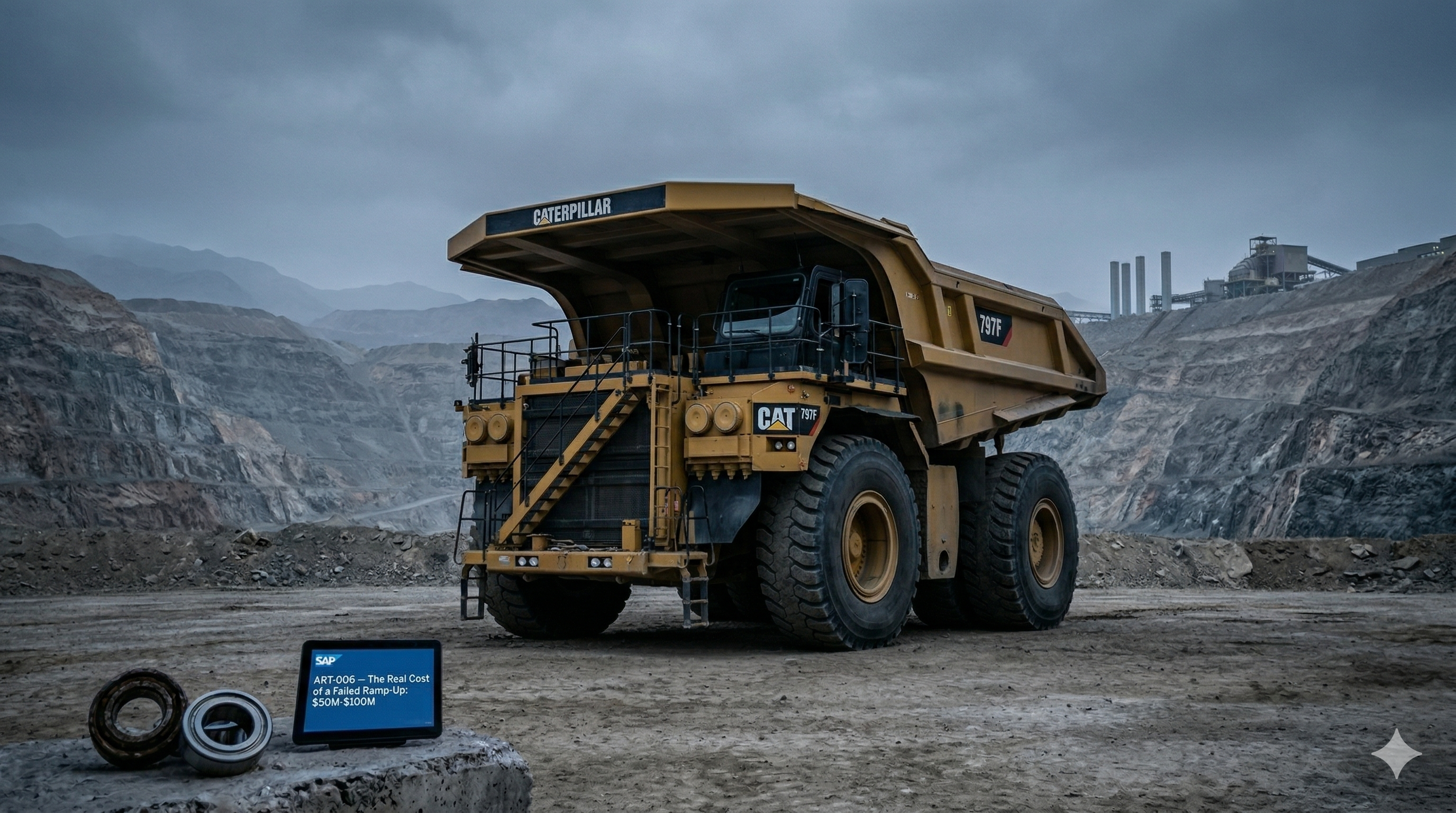
According to McKinsey, 70% of megaprojects suffer delays exceeding 12 months. The most common reason isn't engineering — it's operational preparation. And when the root cause is analyzed, the answer is almost always the same: only 2 or 3 functional areas of OR were covered. The other 10 were left for later.
The problem is that in industrial operations, "later" is extremely expensive.
Why 2 or 3 Pillars Aren't Enough
Ask any consultancy that does Operational Readiness. Most will say the same thing: maintenance strategy and staffing. Some will add operational documentation.
And they're right. Those areas are critical. But they're the starting point, not the finish.
A prepared operation isn't an operation that has a maintenance plan. It's an operation where the right spare parts are already in the warehouse. Where CMMS systems are configured and loaded with data. Where the OPEX budget is built bottom-up, not estimated by reference. Where critical service contracts are signed. Where personnel were not only hired — they were trained, certified, and practiced in the process.
Those aren't implementation activities. They're preparation activities. And if they're not ready on Day 1, the operation pays the difference in lost time, emergency costs, and sacrificed production.
Australia's AMCouncil documented the pattern precisely: maintenance strategies, spare parts, documentation, and trained personnel are frequently not available at the time of handover. It's not negligence. It's that nobody included them in the OR scope.
Our comprehensive methodology covers the 13 functional areas of an operation. Most consultancies focus on 2 or 3. The problems appear in the other 10.
The 13 Pillars of a Prepared Operation
Pillar 1: Maintenance and Reliability Strategy
The starting point of all OR. But "having a maintenance strategy" isn't enough. A real strategy includes asset criticality analysis, application of RCM methodologies where appropriate, definition of preventive and predictive maintenance frequencies, and differentiated strategies by equipment type. Without this, the plant starts up in reactive mode. According to Gartner, reactive maintenance costs 3 to 5 times more than planned maintenance.
Pillar 2: Organization and Staffing
It's not enough to know how many people you need. A ready operation has defined organizational structures, roles, competency profiles for each position, and a recruitment plan with timeline. 45% of industrial executives report concern about workforce readiness at startup, according to PwC.
Pillar 3: Spare Parts and Inventory Management
This pillar fails with astonishing frequency. The plant starts up. A critical pump fails at 30 days. The spare part has 16 weeks of lead time. A prepared spares strategy defines the initial spares list by asset criticality and has inventory physically in the warehouse before commissioning.
Pillar 4: Operational Documentation (SOPs, P&IDs)
Deloitte reports that more than 60% of industrial plants start up without complete SOPs. That means the first-shift operator improvises the procedure. In operations where a sequence error can result in a safety incident, improvising is not an option.
Pillar 5: Management Systems (CMMS/ERP)
An empty CMMS on startup day isn't a management system. It's a blank database. A prepared CMMS has the asset hierarchy loaded, maintenance routines scheduled, spare parts linked, and personnel trained in its use. Direct export to SAP PM is the difference between a plan implemented on Day 1 and one that waits six months.
Pillar 6: OPEX Budget and Cost Control
60% of industrial operations exceed their first-year OPEX by more than 20%, according to Deloitte. A prepared OPEX budget is built bottom-up: every cost line has a technical justification, an industry benchmark, and an owner.
Pillar 7: HSE and Risk Management
A prepared HSE operation is one where every worker knows the risks of their specific task, emergency response procedures are practiced (not just written), and the safety culture doesn't begin in month 3. HSE incidents in the first 90-120 days affect the project's social license and regulatory access.
Pillar 8: Contracts and Suppliers
A prepared operation has contracts signed, not in negotiation. Service level agreements are defined, contractor KPIs are agreed, and plant access protocols are established. Starting negotiations on commissioning day guarantees the first months will be managed with interim providers at spot prices.
Pillar 9: Change Management and Training
Technology without adoption is waste. Procedure without training is paper. This pillar covers technical training, organizational change management, and competency certification before startup — not after. PwC reports 45% of executives identify workforce readiness as their top startup concern.
Pillar 10: Support Infrastructure and Services
This pillar is systematically underestimated. An operation needs more than the main plant. It needs functional camp, communications, water, auxiliary power, road access, equipped warehouses, and workshops with the tools needed for planned maintenance.
Pillar 11: Commissioning and Startup
Commissioning isn't an event — it's a process with stages, acceptance criteria, and defined owners. BCG documents that the "valley of death" costs between 5% and 15% of total project CAPEX. In a $500M project, that's $25M to $75M in destroyed value.
Pillar 12: Governance and Readiness KPIs
You can't manage what you don't measure. A prepared operation has an active OR governance system from early project phases: readiness KPIs by functional area, periodic gate reviews with defined approval criteria, and executive visibility of actual readiness status.
Pillar 13: Knowledge Transfer and Continuity
This is the pillar that separates an OR that works on day one from one that works in year one, year five, and year ten. A prepared knowledge transfer goes beyond document handover. It includes structured handover models, mechanisms to codify tacit knowledge, and systems so the organization doesn't reinvent the wheel when staff rotates.
What Happens When Pillars Are Missing
The pattern is predictable. The first 30 days of operation reveal the missing pillars. If Pillar 3 isn't covered, critical equipment is out of service without available spares. If Pillar 4 failed, an operator improvises a procedure and there's an HSE incident. If Pillar 6 was an estimate, the first quarter budget is already in the red.
Each missing pillar has a direct cost — in time, money, or lost production. BCG estimates the valley of death costs between 5% and 15% of CAPEX. For a $1 billion project, that's $50M to $150M destroyed in the first months.
Covering All 13 in 90-120 Days
The obvious question: if covering 2 or 3 pillars already takes 12 to 24 months with teams of 10 to 15 consultants, how is it possible to cover all 13 in 90-120 days?
The answer isn't doing less. It's doing differently.
Ausenco, one of the market's OR references, has the capacity for broad scope. It needs 150 professionals and 12 months. VSC delivers the same result with 2 to 3 people in 90-120 days, at a fraction of the cost.
The difference isn't magical. It's methodological.
VSC has built a proprietary analytical framework that covers the 13 functional areas simultaneously, not sequentially. Each area has structured methodology, diagnostic tools, and deliverable templates validated against industry standards.
What multiplies the team's capacity are VSC's in-house agentic tools. They're not generic AI. They're systems specialized by discipline, built on years of experience operating mines and megaprojects across four continents. Every deliverable passes through expert validation before release. Speed doesn't sacrifice quality — it guarantees it.
The result is measurable: 91 out of 100 across 7 auditable dimensions.
And most importantly: the generated knowledge doesn't leave when the VSC team finishes. It stays codified in the client's systems.
The OR Readiness Scorecard
A question every project manager or VP of Operations should be able to answer: right now, how many of the 13 pillars are covered in my project?
If the answer takes more than two minutes, there's already a governance problem.
VSC has an OR Readiness Scorecard with 13 dimensions and 65 evaluation points. It diagnoses the real state of operational readiness in 15 minutes.
Ready to talk about your operation?
30 minutes. Your specific case. Honest assessment.
Schedule a Meeting with VSC